
All TCM theories including physiology, pathology and regimen are based on and encompassed the same principles,
therefore the first several chapters will be used to introduce and explain them.
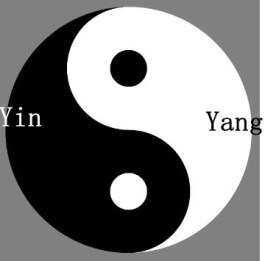
This Taiji picture may not be strange to you, however its implication never fully clear in your mind. In fact, any single SYSTEM can be viewed as a Taiji, no matter how big or small its spectrum is, such as a cell, an organ, a body, the earth and the solar system, all of them can be viewed as a Taiji.
The correlation of different Taiji is characterized by similarity— they fall into similar patterns in different places and times. An atomy is encircled by electrons, the earth is encircled by the moon, and the sun is encircled by nine planets, for example. Human body originates from an oosperm, after innumerable reproduce and fission for nine months a fetus is mature in uterus—thus every cells possess similar framework. Similar viewpoint goes for the holographic theory —-a drop of water reflects all the information of the universe.


The reflexology theory, such as hands, foot, ears, and facial reflexology , are very good examples of Taiji similarity,according to which all major organs are compactly reflected on our hands, foot, ears and facial etc. This theory are frequently used by the acupuncture practitioners and massage therapists, especially when they are treating and healing some physical pain and surprising results always be achieved.


Another character of the correlation of different Taiji is hierarchy— they fall into different level in different places and times. A cell, an organ, a body, the earth and the solar system will fall into different levels according to its context. We need to be aware of the conversion between different levels of one single Taiji, as this will happen frequently in the Entirety and Parts relation model.
In TCM, the Entirety and Parts relation model is named “象数理 Xiangshuli” , in which “象Xiang” refers to the Entirety, and the “数shu” refers to the Parts which consist of the Entirety, hence the correlations between the Entirety and Parts fall into certain Rules, which is call “理Li”.
象 Xiang Entirety Information
理 Li rules Energy
数 Shu Parts Data
For example, being assumed as the studying object, Canada can be viewed as an Entirety and the 10 provinces consist of the country can be viewed as Parts. Deductively, when the studying object is switched to a given province, the province becomes an Entirety/Xiang, and the Parts/Shu can be switched to the cities constituting the province. Therefore, a given object can either be the Xiang, comparing with its lower level, or be the Shu, comparing with its upper level.
Take human body as an example. The Entirety/Xiang of a body can be viewed as 5 Parts/Shu, which are liver, heart, spleen, lungs, kidney, and the Rules/Li between them is called “五行 Wuxing” in Chinese (which can be translated as Five Movements). Deductively, the body can be viewed into 6, 7…12, 100, even to millions parts as well, infinitely, according to our different research needs.
However, did you notice that if we view a Xiang as too much parts, we are prone to forget about the holistic picture? If we view the body as 100 parts, will we get lost in them? When we over concentrate on a given ecological cluster too much, instead of the balance of whole ecosystem, can we figure out the right solutions to harmonize the ecosystem? Morden medicine is formidable at analysing different parts, but falls short of getting the big picture of body. Contrarily, the TCM has an innate advantage at discerning and governing the Entirety/Xiang. Therefore, generally speaking, TCM would only view the body into 5 (Wuxing, Five Movements) to 6 parts (Liujing, Six meridians) or 12 parts (Shi’er Jing, 12 merdians) at most, avoiding from be lost in Parts/Shu. The most distinctive difference between TCM and western Medicine is that TCM looks for solutions by a holistic approach, which is represented as XiangShuli thinking paradigm here.
 taoistmedicine.org